Why Your Child Can Read a Story but Struggles to Retell It Clearly
June 10, 2026 · 8 min read · Reading & Comprehension
Parents want to understand why their child can read words correctly but cannot explain the story. They are also looking for reassuring, practical ways to build comprehension and storytelling skills.
Why Your Child Can Read a Story but Struggles to Retell It Clearly
Quick Summary
Reading words and understanding a story are related but different skills.
Retelling requires memory, sequencing, vocabulary, cause-and-effect thinking, and expression.
Small prompts such as "What happened first?" work better than "Tell me the whole story."
Everyday routines and picture sequences offer useful, low-pressure practice.
Your child reads a page aloud without much difficulty. Then you ask, "What happened in the story?" and hear, "I don't know," or receive a one-word reply.
This is a common concern. Reading words and understanding, organising, and explaining a story are separate tasks. Retelling asks a child to remember events, decide what matters, put ideas in order, and express them clearly.
These skills can be practised gently through shared reading, conversation, familiar routines, and visual storytelling activities at home.
Reading Words Is Not the Same as Understanding a Story
When children recognise or sound out printed words, they are using decoding skills. Comprehension requires them to build meaning from those words.
A child may read each sentence accurately but still struggle to answer:
Who was the story about?
What happened first?
What was the problem?
Why did it happen?
How did it end?
Reading research commonly describes skilled reading as a combination of word recognition and language comprehension.Reading Rockets explains how decoding, fluency, vocabulary, and comprehension work together.
Retelling adds another challenge: the child must reorganise what they understood into an explanation that someone else can follow.
Why Retelling Is Harder Than It Looks
It depends on memory
Children must hold several events in mind while deciding which details are important. A younger child may remember the funniest picture or the ending but forget the events that connected them.
It requires sequencing
A story usually has an order: something begins, a change or problem occurs, characters respond, and the story reaches an ending.
Children may need help connecting events with words such as "first," "next," "because," and "finally."Story-sequencing activities make this structure easier to see and practise.
It requires cause-and-effect thinking
Retelling is more than listing events. Children also need to explain how one event led to another.
For example:
"Aarav forgot his umbrella, so he got wet."
Questions such as "Why did that happen?" and "What happened because of it?" help children practise these connections.
It requires expressive language
A child may understand the story but struggle to find the right words quickly or form a connected explanation.
This can be noticeable in multilingual homes. A child may explain an idea more confidently in Tamil, Hindi, Bengali, Kannada, Marathi, or another home language than in the language used at school.
Letting the child retell first in a familiar language can show you what they understood. India's National Curriculum Framework for the Foundational Stage also supports using children's home languages as a bridge to learning other languages.
Signs Your Child May Need More Storytelling Practice
Brief answers are not always concerning. Children may respond with few words when they are tired, distracted, shy, or uninterested in a book.
More practice may help when your child frequently:
names characters but cannot explain what they did;
mixes up the order of events;
jumps from the beginning to the ending;
describes pictures separately without connecting them;
answers "what" questions but struggles with "why" or "how."
These are not diagnostic signs. They are clues that the child may benefit from smaller prompts, visual support, and more time to answer.
Why Storytelling Skills Matter
Retelling helps children practise:
remembering information;
organising ideas logically;
using vocabulary in context;
forming connected sentences;
understanding cause and effect;
explaining actions, motives, and feelings.
These abilities are useful beyond books. Children use them when explaining what happened at school, describing a disagreement, giving instructions for a game, recounting a family outing, and later organising ideas in writing.
Longitudinal early-literacy research has found associations between children's oral narrative skills around school entry and later reading comprehension.
This does not mean storytelling alone determines academic success. It means that understanding and organising spoken stories is one part of a broader literacy foundation.
India's National Curriculum Framework for the Foundational Stage similarly emphasises oral language, storytelling, picture conversations, shared reading, and meaning-making during the early years.
Five Simple Activities to Try at Home
Keep the activities short and conversational. The goal is not to test your child after every book, but to give them regular opportunities to organise and express ideas.
1. Ask "First, Next, Then, Last"
After a short story, ask:
What happened first?
What happened next?
What changed?
How did it end?
Use the same questions for brushing teeth, getting ready for school, making a snack, tidying toys, or preparing diyas before a festival.
Familiar routines allow children to focus on order rather than remembering unfamiliar details.
2. Find the Main Change
Ask:
"What was different at the end?"
Then ask:
"What caused that change?"
This helps children identify the central event instead of listing every small detail. For younger children, offer two possible answers and let them choose.
3. Build a Cause-and-Effect Chain
Choose one event and ask:
Why did it happen?
What happened because of it?
What could the character have done differently?
For example:
"Meera left her crayons on the floor. What happened next?"
The child might say that someone stepped on them, they broke, or Meera could not find them later. More than one sensible answer may be possible.
4. Arrange and Retell Picture Sequences
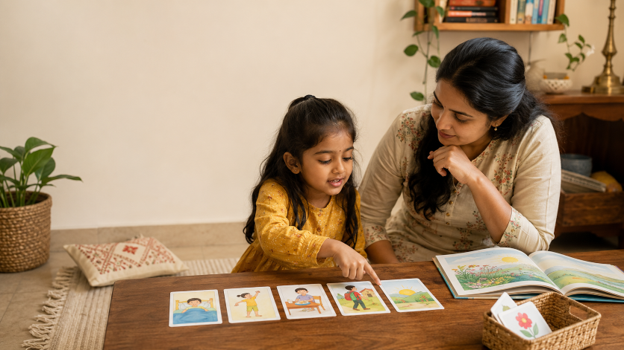
Use three to five pictures showing an everyday event. Mix them up and ask your child to arrange them in order.
Then invite the child to tell the story. Model connecting words naturally:
"First the seed was planted. After that it was watered. Finally, a small plant grew."
Pictures reduce the need to remember everything and make the structure of a story visible.
5. Retell One Moment From the Day
At dinner or bedtime, ask each family member to share one small event, such as helping a grandparent, sharing lunch, missing the school bus, or preparing for a festival.
Prompt gently:
Who was there?
What happened first?
How did you feel?
How did it end?
Personal stories connect language practice with emotions, family conversation, and everyday Indian life.
Age-Wise Guidance
Ages 4-5
Begin with two- or three-step sequences involving familiar actions. Encourage children to name who was involved, what happened, and what came next.
Accept short answers and expand them rather than correcting them.
When your child says, "Boy fell," you might reply:
"Yes, the boy fell because the floor was wet."
Ages 6-7
Encourage children to include a beginning, a problem or change, important events, and an ending.
Ask simple questions about motives and consequences:
"Why did she do that?"
"What happened because of her decision?"
Ages 8-10
Move towards inference, perspective, and writing.
Ask:
How might each character have felt?
Was the decision fair?
What clues support your answer?
How could the ending be changed?
Children can also turn an oral retelling into a paragraph, comic strip, diary entry, or alternative ending.
A Gentle, Screen-Free Way to Practise
Picture-based storytelling tools can make retelling feel more manageable because children have something concrete to observe, arrange, and discuss.
LernZeit Creations' Storytelling & Sequencing Flashcards use five-card story sets to help children place events in order, describe what is happening, connect causes and outcomes, and retell the sequence in their own words.
A child can begin by naming one picture at a time. Through repeated parent-child conversation, they can gradually connect the pictures using words such as "because," "after," and "finally."
The cards are a playful, screen-free support, not a replacement for shared reading, everyday conversations, or family storytelling. They offer a clear visual structure when the open-ended question "What happened?" feels difficult.
Frequently Asked Questions
My child remembers the events but tells them in the wrong order. Is that a problem?
Not necessarily. Your child may understand the events but still need help organising them.
Ask for only three parts at first:
What happened at the beginning?
What was the main change or problem?
How did it end?
Add more details once that structure is clear.
Should I correct grammar during every retelling?
Let your child finish first. Then model a clearer sentence naturally.
Child: "Girl go shop and lose bag."
Parent: "Yes, the girl went to the shop, and then she realised she had lost her bag."
The immediate goal is clear communication, not perfect grammar.
Can my child retell the story in a home language?
Yes. Retelling in a familiar language can reveal what the child understood without making second-language vocabulary an additional barrier.
You can then help translate a few important words or sentences into the language used at school.
Key Takeaways
Reading words accurately does not always mean a child can explain the story.
Retelling combines comprehension, memory, sequencing, vocabulary, and expression.
Small, specific questions are often more helpful than one broad question.
Familiar routines, family experiences, and pictures provide meaningful practice.
Warm, regular conversation matters more than a perfect retelling.
References
Reading Rockets.What Is Reading?
Reading Rockets.Story Sequence
Suggate, S., Schaughency, E., McAnally, H., and Reese, E.From Infancy to Adolescence: The Longitudinal Links Between Vocabulary, Early Literacy Skills, Oral Narrative, and Reading Comprehension. Cognitive Development, 2018.
National Council of Educational Research and Training.National Curriculum Framework for the Foundational Stage 2022.