
My child lacks confidence while speaking. What do I do?
July 8, 2026 · 9 min read · Language & Communication
Parents want to understand why their child knows an answer but hesitates to speak, gives one-word responses, or lacks confidence expressing ideas. They are seeking gentle, practical ways to support communication without forcing the child to perform.
How Storytelling Builds Speaking Confidence in Children Without Pressure
Does your child know the answer but hesitate to say it? Some children need extra time to organise their thoughts, find the right words, or feel safe enough to speak. Speaking confidence is not built only through recitations, stage performances, or public-speaking classes. It can grow through small, repeated, low-pressure conversations with a trusted adult. Storytelling gives children a helpful structure: they can observe a picture, arrange events, and gradually connect ideas into sentences. This article explains why children may hesitate and how parents can use simple storytelling activities to support clearer, more confident expression.
Quick Summary
Quiet or hesitant speech does not automatically mean a child lacks knowledge.
Pictures and sequences give children something concrete to discuss.
Retelling can support sentence formation, vocabulary, sequencing, and clarity.
Patient pauses and gentle prompts reduce the feeling of being tested.
Speaking confidence grows through regular conversation, not pressure to perform.
Why Some Children Know the Answer but Do Not Say It
A child may answer freely at home but become silent in class, use single words despite understanding the idea, or abandon a sentence halfway through.
The child may be cautious, need more processing time, worry about mistakes, or find it difficult to retrieve vocabulary quickly. Speaking in a less familiar language can add effort. Quietness is not a flaw to "fix"; the aim is to create safe opportunities to practise sharing ideas.
Responsive, back-and-forth exchanges with caring adults support early communication and social development. Harvard's Center on the Developing Child describes these exchanges as "serve and return": the child communicates, and the adult responds meaningfully.
Why Storytelling Makes Speaking Easier
Pictures Reduce Pressure
"Tell me something" requires the child to choose a topic, organise details, and find the words at once. A picture narrows the task. The child can begin with something visible:
"I see a girl holding an umbrella."
The parent can then ask:
"Where is she going?"
"How do you know it is raining?"
Wordless pictures create opportunities to notice details, listen, speak, and form stories without depending on one memorised answer.
Sequences Give Thoughts a Structure
A story sequence answers an important question:
"What should I talk about next?"
The child can move through the pictures using simple connectors such as:
First…
Next…
Because…
After that…
Finally…
Instead of inventing everything from nothing, the child observes, orders, and explains.
A child who initially says, "Boy fell," may gradually learn to say:
"First, the boy was running. Then he slipped because the floor was wet."
The sequence provides a visible path for the explanation.
Retelling Builds Language
When children retell stories, they practise choosing words, linking events, describing characters, and forming connected sentences.
A review of 11 studies involving toddlers and preschoolers found that story-retelling practices were associated with gains in story comprehension, expressive vocabulary, receptive language, and early literacy. These findings make retelling one useful language activity, not a guarantee of a particular outcome.
By ages 4-5, many children are developing longer sentences and beginning to include characters, settings, and connected events in stories. Development varies, so milestones are guides rather than deadlines.
Conversation Works Better Than Constant Correction
Parents naturally want to help when a child says:
"Boy fall water."
Correcting every word may make a hesitant child focus on mistakes rather than meaning.
Try expanding the sentence instead:
Child: "Boy fall water."
Parent: "Yes, the boy slipped because there was water on the floor."
The child hears a fuller model without being told the attempt was wrong.
It also helps to pause rather than repeat the question or supply the answer. ASHA recommends attentive listening, allowing response time, and adding to what a child says.
This approach is sometimes called language expansion. The parent accepts the child's idea and gently models a clearer or more complete version.
The goal is not to ignore grammar indefinitely. It is to protect the child's willingness to communicate while showing how ideas can be expressed more clearly.
Five Low-Pressure Storytelling Activities at Home
1. Begin With "Tell Me What You See"
Choose a picture from a book, family album, magazine, or picture card.
Ask:
Who is in the picture?
What are they doing?
What did you notice first?
Accept pointing or one-word answers initially and expand them naturally. Family photographs can prompt conversations about making rangoli, visiting grandparents, or preparing for a festival.
For example:
Child: "Dadi. Diyas."
Parent: "Yes, Dadi is arranging the diyas for Deepavali."
2. Imagine What Happened Before and After
Show one picture and ask:
What happened before this?
What might happen next?
What clue helped you decide?
Several answers may be sensible, which can help a child who fears being wrong.
Take turns answering. When a parent offers an imaginative response first, the activity feels more like shared play and less like a test.
3. Arrange and Narrate One Card at a Time
Give the child three to five pictures from a clear sequence. Ask them to arrange the cards and describe only the first one.
Move through the cards gradually, then help the child join the sentences into one retelling.
This observe-arrange-narrate process divides a large speaking task into manageable steps. A hesitant child does not need to remember and explain the entire story immediately.
4. Talk About Feelings and Motives
Try asking:
How is the child feeling?
What makes you think that?
Why did the character do that?
What could someone say to help?
ASHA suggests using pictures, familiar stories, pretend play, and family photographs to discuss characters, actions, and feelings.
These questions also help children practise emotional vocabulary such as disappointed, nervous, relieved, worried, proud, and excited.
5. Build One Full Sentence Together
When the child gives a short answer, help build one complete sentence.
Child: "Grandma cooking."
Parent: "Grandma is cooking what?"
Child: "Payasam."
Together: "Grandma is cooking payasam for the festival."
Say, "Let us put your ideas together," rather than "Say it properly," so the adult feels like a partner rather than an evaluator.
Helpful Prompts That Do Not Feel Like a Test
Use one prompt at a time:
"Tell me what you see."
"What happened first?"
"How is the child feeling?"
"What makes you think that?"
"Can we put that into one full sentence?"
"What would you do next?"
Avoid asking several questions rapidly. Respond with interest before moving to the next prompt.
You can also replace questions with comments. Instead of always asking, "What is happening?" say:
"I noticed that the child is hiding something behind her back."
A child may respond more naturally to an interesting observation than to a direct question.
In multilingual Indian homes, allow the child to tell the story in the language that comes most naturally. You can then model a sentence in English or another school language. ASHA advises families to talk, play, read, and listen together in all the languages they use at home.
Age-Wise Guidance
Ages 4-5
Begin with naming, describing, and two- or three-picture sequences. Help the child form simple sentences about who, what, and where.
Use playful voices, puppets, or familiar routines such as brushing teeth, packing a bag, or helping serve food.
Accept short responses. Model a slightly longer sentence without expecting the child to repeat it perfectly.
Ages 6-7
Encourage a beginning, middle, and end. Help children connect ideas using "then," "because," and "so."
They can retell a classroom event, explain how a festival decoration was made, or describe what a character wanted.
Ask one follow-up question that encourages detail:
"What happened because of that?"
Ages 8-10
Move towards opinions, perspective, and explanation:
Which character made the better decision?
What supports your idea?
How could the problem be solved differently?
How might another character describe the same event?
Children can also turn an oral story into a diary entry, comic strip, paragraph, or alternative ending.
A Screen-Free Tool for Speaking Practice
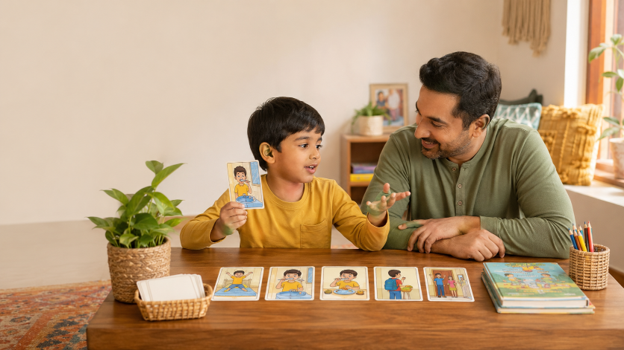
Picture-based flashcards can make expression easier because the child does not have to begin with an empty topic. They can first observe, then arrange, narrate, and discuss.
LernZeit Creations' Storytelling & Sequencing Flashcards use five-card story sets that give children a visible path through a story. A child may begin by naming objects, then describe each card, connect the events, explain why something happened, and imagine what could happen next.
Used as a relaxed parent-child activity, the cards can support communication, vocabulary, sequencing, and speaking confidence without turning the conversation into a formal lesson.
The parent does not need to search for the "correct" narration. The same cards can support several conversations:
What do you notice?
What happened first?
Why did that happen?
How is the person feeling?
What might happen next?
Could the story end differently?
The flashcards are one screen-free practice tool alongside family stories, shared reading, pretend play, and everyday conversation.
When Extra Support May Be Helpful
Some children are simply quiet and communicate well when comfortable. Seek professional guidance if you are concerned about speech clarity, understanding language, forming sentences, communicating in familiar settings, or a loss of previously used skills.
Developmental checklists cannot diagnose a child at home. ASHA notes that children develop at different rates and recommends professional assessment when a child is not meeting many milestones in the relevant age range.
Parents can begin by discussing their observations with the child's teacher or paediatrician. A qualified speech-language professional can assess whether the child needs additional support.
Frequently Asked Questions
Should I make my shy child speak in front of relatives?
Inviting is better than forcing. Offer a small role, such as showing one picture or saying one sentence, and allow the child to decline.
Confidence is more likely to grow when participation feels safe and achievable.
Should I correct incomplete sentences?
Listen to the meaning first, then model a fuller version. Correct when clarification is needed, but avoid interrupting every attempt.
A conversation should not feel like a grammar examination.
Can storytelling help a child who speaks confidently only at home?
It may provide a useful bridge. Begin with a trusted adult, then include a sibling or friend, and later try a small familiar group.
Keep the same story or pictures so that only the audience changes, not the entire task.
Key Takeaways
Speaking confidence develops through small, responsive conversations.
Pictures and sequences reduce the need to invent everything at once.
Retelling helps children practise vocabulary, sentence formation, clarity, and structure.
Listening, pausing, and expanding words are often more helpful than constant correction.
The goal is meaningful expression, not a perfect performance.
References
Center on the Developing Child at Harvard University.Serve and Return: Back-and-Forth Exchanges.
Dunst, C., Simkus, A., and Hamby, D.Children's Story Retelling as a Literacy and Language Enhancement Strategy. CELLreviews, 2012.
American Speech-Language-Hearing Association.Communication Milestones: 4 to 5 Years.
Communication Health Support Association, powered by ASHA expertise.Tips for Your Child's Speech and Language Development.
American Speech-Language-Hearing Association.Eight Speech and Language Skills to Practise With Your Preschooler at Home.
Reading Rockets.Sharing Wordless Picture Books.